PsyOpus

Our Instruments

The 5 Stack Solution

A complete framework for organisational effectiveness

Five evidence-based psychometric instruments that work from the individual outward — building collaborative maturity at every level of your organisation.

01

Individual Level

Individual Insight

Personality

PPI-5

PsyOpus Personality Inventory — Big Five

Understanding the personality foundations that shape how individuals think, relate, and perform at work is the starting point for all development. The PPI-5 provides a rigorous, evidence-based assessment of the Big Five personality traits in a workplace context.
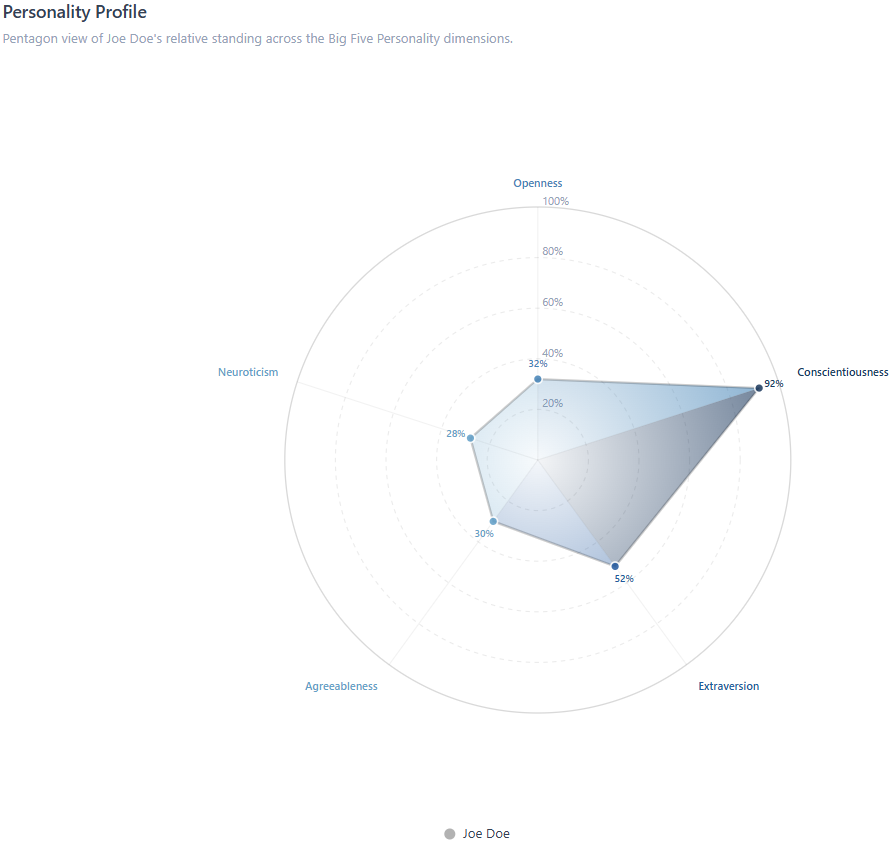
PPI-5 Personality Profile
Click to enlarge

PPI-5 Personality Profile

Scale

50 items · 5-point scale

Domains

  • Experiential
    Curiosity, drive for new experiences, openness to ideas
  • Volitional
    Self-discipline, goal-directedness, conscientiousness
  • Interpersonal
    Sociability, assertiveness, warmth
  • Emotional
    Emotional stability and regulation under pressure

Constructs

OpennessOpennessThe tendency to seek out and appreciate new experiences, ideas and perspectives. Reflects intellectual curiosity, creativity, and receptiveness to change in the workplace.ConscientiousnessConscientiousnessThe tendency to be organised, reliable, self-disciplined and goal-directed. Reflects the degree to which an individual plans carefully and follows through on commitments.ExtraversionExtraversionThe tendency to seek stimulation in the company of others. Reflects sociability, assertiveness, energy, and a preference for engaging with people and the external environment.AgreeablenessAgreeablenessThe tendency to be cooperative, trusting, and empathetic. Reflects concern for social harmony, sensitivity to others' needs, and a collaborative orientation in interpersonal relationships.NeuroticismNeuroticismThe tendency to experience negative emotions such as anxiety, irritability, and emotional instability. Reflects emotional reactivity and vulnerability to stress under pressure.
02

Leader Level

Leadership Performance

Attunement

LSS-2 & LSS-3

Leadership Synergy Scale — Second & Third Edition

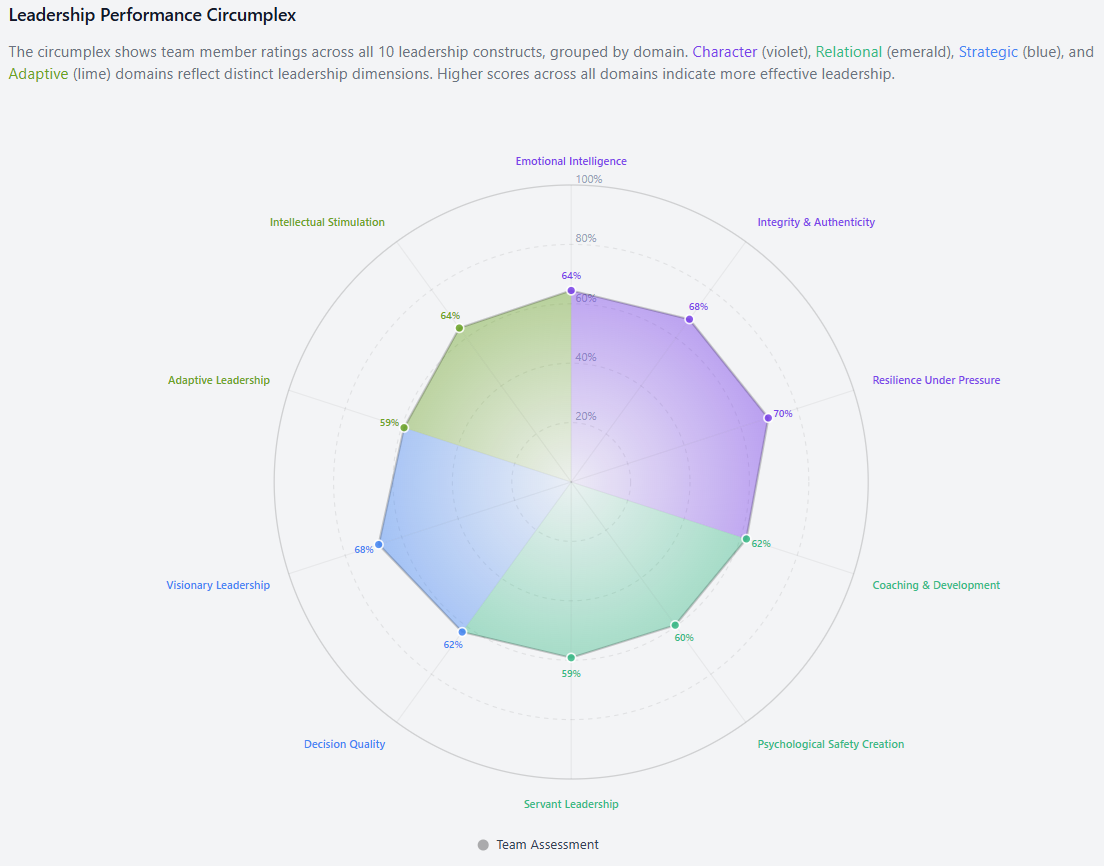
Leadership effectiveness depends not only on what a leader thinks they do, but how their team actually experiences their leadership. The LSS measures synergy between leader self-perception and team perception — revealing attunement gaps that limit performance.

LSS-2Team rates leader + leader self-rates → Leadership Attunement score
LSS-3Team-only rating — no self-assessment required

Scale

50 items · 7-point scale

Domains

  • Character
    Integrity, authenticity, emotional intelligence, resilience
  • Relational
    Psychological safety, coaching, servant leadership
  • Strategic
    Visionary leadership, decision quality
  • Adaptive
    Adaptive leadership, intellectual stimulation

Constructs
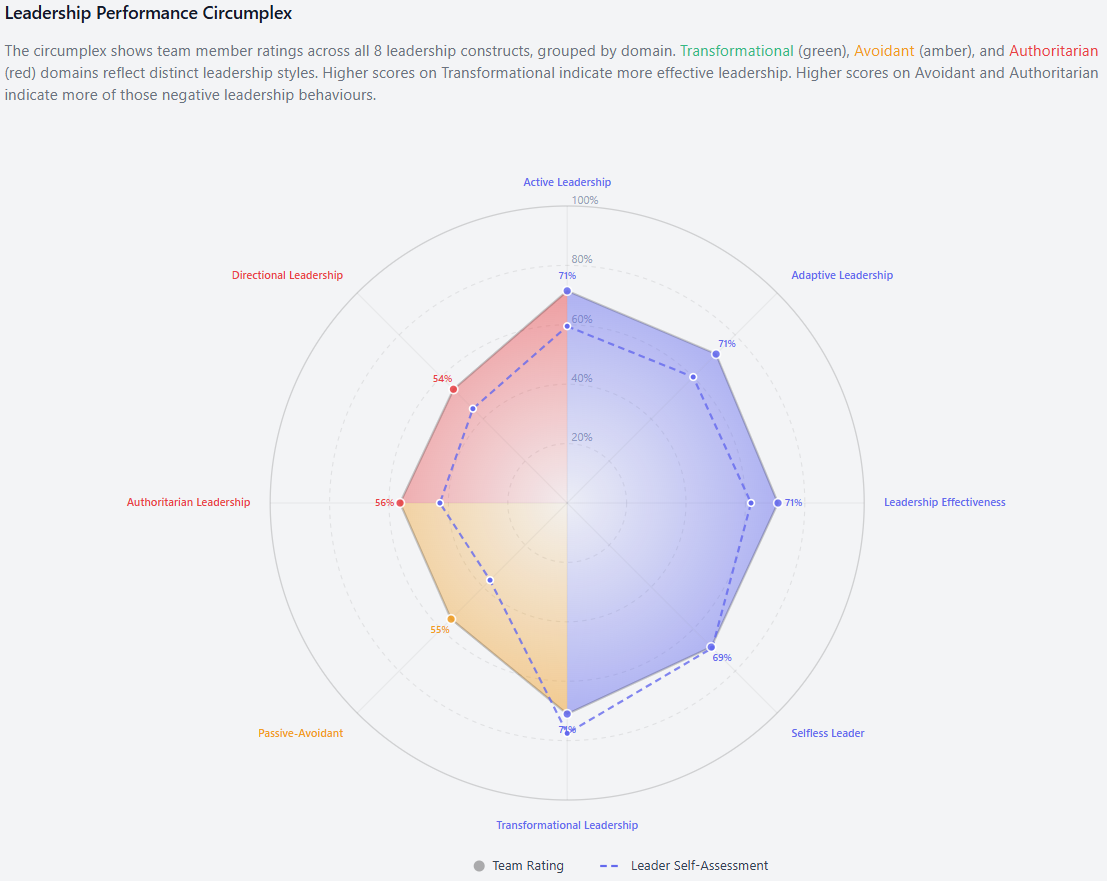
Integrity & AuthenticityIntegrity & AuthenticityLeading with honesty and consistency between stated values and actions. Reflects a leader who is genuine, transparent and trustworthy — doing what they say and saying what they mean.Emotional IntelligenceEmotional IntelligenceThe capacity to recognise, understand and manage one's own emotions, and to respond effectively to the emotions of others. Foundational to empathetic and attuned leadership.Resilience Under PressureResilience Under PressureThe ability to maintain composure, effectiveness and positive leadership under stress, adversity or significant organisational challenge. Reflects psychological robustness and adaptive coping.Psychological Safety CreationPsychological Safety CreationCreating an environment where team members feel safe to speak up, take risks, ask questions and raise concerns without fear of ridicule or punishment.Coaching & DevelopmentCoaching & DevelopmentActively developing the capability and potential of team members through feedback, guidance, stretch opportunities and growth-focused conversations.Servant LeadershipServant LeadershipPrioritising the needs of the team above self-interest. Enabling others to perform at their best by removing barriers, providing support, and sharing credit.Visionary LeadershipVisionary LeadershipArticulating a compelling future direction and inspiring others to commit to and work toward a shared organisational vision with clarity and conviction.Decision QualityDecision QualityMaking sound, timely and well-reasoned decisions. Reflects the ability to balance analytical rigour with practical judgement and to involve others appropriately.Adaptive LeadershipAdaptive LeadershipFlexibly adjusting leadership style and approach to meet changing circumstances, individual team member needs, and evolving organisational demands.Intellectual StimulationIntellectual StimulationEncouraging team members to think creatively, challenge existing assumptions, and approach familiar problems in new and innovative ways.
LSS-2 Leadership Circumplex
Click to enlarge

LSS-2 Leadership Circumplex

LSS-3 Leadership Circumplex
Click to enlarge

LSS-3 Leadership Circumplex

03

Team Level

Team Performance

Alignment

TSS

Team Synergy Scale

Transformational team performance only occurs when the hard work of foundational goal and role clarity is achieved first. The TSS assesses the full spectrum of psychological conditions that drive team synergy — from the basics of direction-setting through to flow states and innovative adaptation.
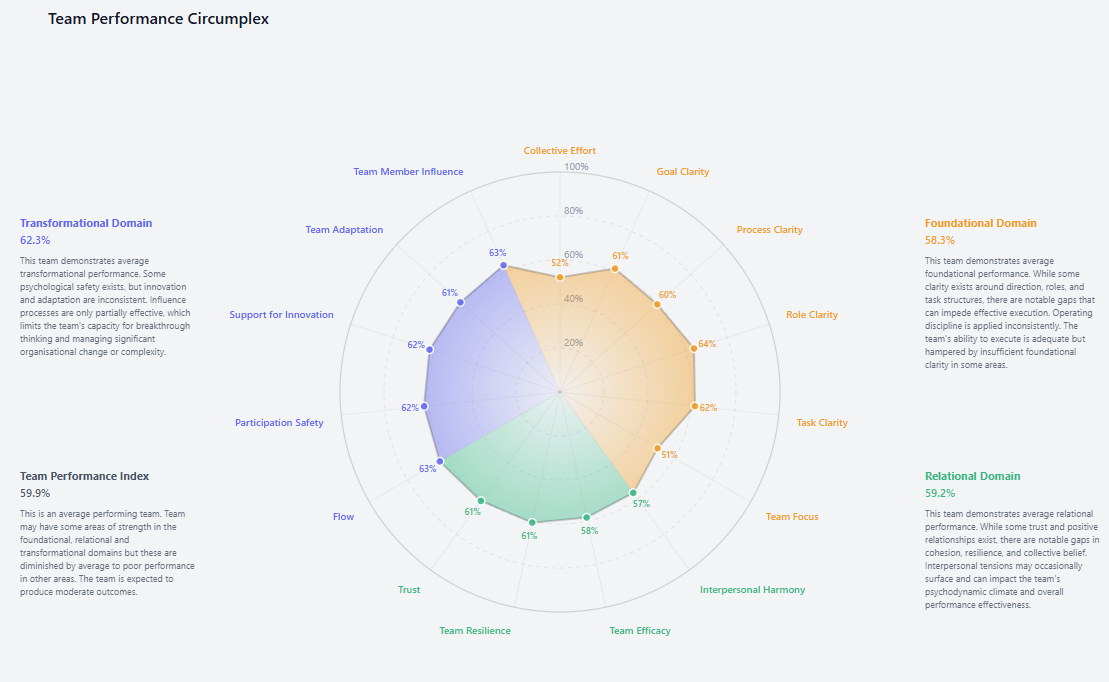
TSS Team Performance Circumplex
Click to enlarge

TSS Team Performance Circumplex

Scale

95 items · 7-point scale

Domains

  • Foundational
    Goal, role, task and process clarity — the anchor of day-to-day execution
  • Relational
    Trust, resilience, efficacy and the interpersonal climate that keeps teams cohesive
  • Transformational
    Participation safety, innovation, adaptation and flow — conditions for breakthrough performance

Constructs

Goal ClarityGoal ClarityThe degree to which team members share a clear, common understanding of the team's purpose, priorities and objectives — the 'why' and 'what' of the team's work.Role ClarityRole ClarityThe extent to which each team member understands their specific responsibilities, accountabilities, and how their role contributes to overall team outcomes.Task ClarityTask ClarityClear understanding of the specific tasks and activities required to achieve team goals — the concrete 'how' of day-to-day execution.Process ClarityProcess ClarityShared understanding of how the team operates together — including decision-making processes, communication norms, meeting rhythms, and ways of resolving conflict.TrustTrustThe confidence team members have in each other's intentions, competence and reliability. Reflects the degree of psychological safety at the interpersonal level within the team.Team ResilienceTeam ResilienceThe collective capacity to adapt, recover and maintain performance in the face of setbacks, pressure or significant change — bouncing forward rather than simply back.Team EfficacyTeam EfficacyThe team's shared belief in its collective capability to organise and execute the actions required to achieve team goals, even under challenging conditions.Participation SafetyParticipation SafetyThe degree to which team members feel safe to contribute ideas, challenge thinking, raise concerns and engage actively in team discussions without fear of negative consequences.Team InfluenceTeam InfluenceThe extent to which team members have genuine input into team decisions, strategic direction, and how the team organises itself — a sense of shared ownership.Innovation SupportInnovation SupportThe climate within the team that encourages creative thinking, experimentation, and the exploration of new approaches — where novel ideas are welcomed rather than dismissed.Team AdaptationTeam AdaptationThe team's ability to adjust its strategies, processes and collective behaviours in response to changing demands, new information, or shifting organisational context.Flow StateFlow StateA peak performance state in which the team operates with high focus, energy and intrinsic motivation — characterised by seamless coordination, shared momentum and a sense of collective engagement.
04

Program Level

Program Integration

Systems

PSS

Program Synergy Scale

Complex programs and major projects require multiple teams to work as one integrated system. The PSS measures coordination health between teams operating within a shared program — evaluating cross-team trust, information flow, goal alignment, and the psychological safety conditions needed for effective inter-team collaboration.
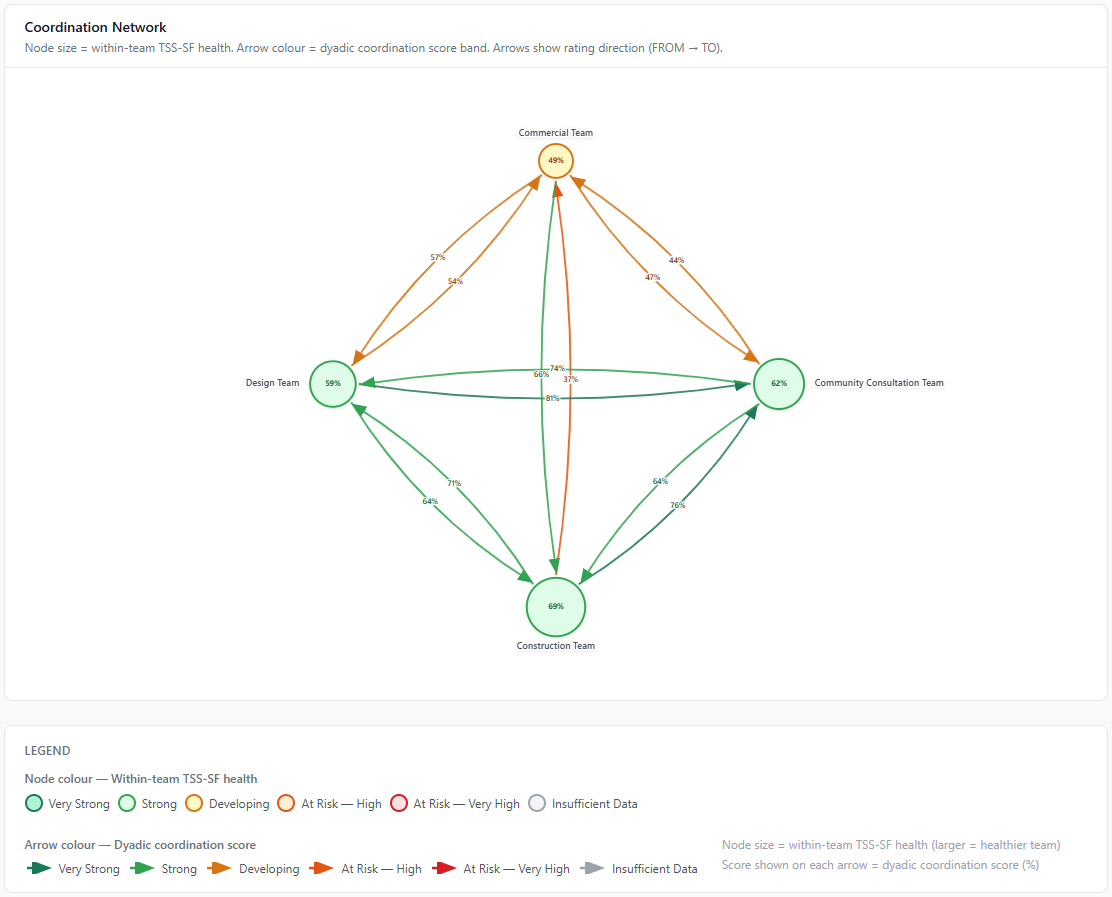
PSS Coordination Network
Click to enlarge

PSS Coordination Network

Scale

In development

Domains

  • Trust
    Competence-based and care-based trust between teams
  • Coordination
    Effectiveness of handovers, information flow and cross-team processes
  • Alignment
    Shared goals and psychological safety across team boundaries

Constructs

Coordination EffectivenessCoordination EffectivenessThe degree to which two teams work together smoothly — including handovers, joint processes, and the reliability of cross-team interactions.Inter-team Trust — CompetenceInter-team Trust — CompetenceThe confidence one team has in another team's ability to deliver on their commitments and perform their role effectively within the program.Inter-team Trust — CareInter-team Trust — CareThe belief that another team genuinely cares about the wellbeing of others and will act in the broader program's interest, not just their own.Information FlowInformation FlowThe quality and timeliness of information shared between teams — ensuring each team has what it needs to make decisions and complete work.Goal AlignmentGoal AlignmentThe extent to which teams share a common understanding of program objectives and work toward compatible rather than competing goals.Inter-team Psychological SafetyInter-team Psychological SafetyThe degree to which teams feel safe to raise concerns, flag problems, and have candid conversations with other teams without fear of blame or retaliation.
05

Workforce Level

Workforce Insights

Performance & Safety

WSS + PRS

Workplace Synergy Scale + Psychosocial Risk Scale

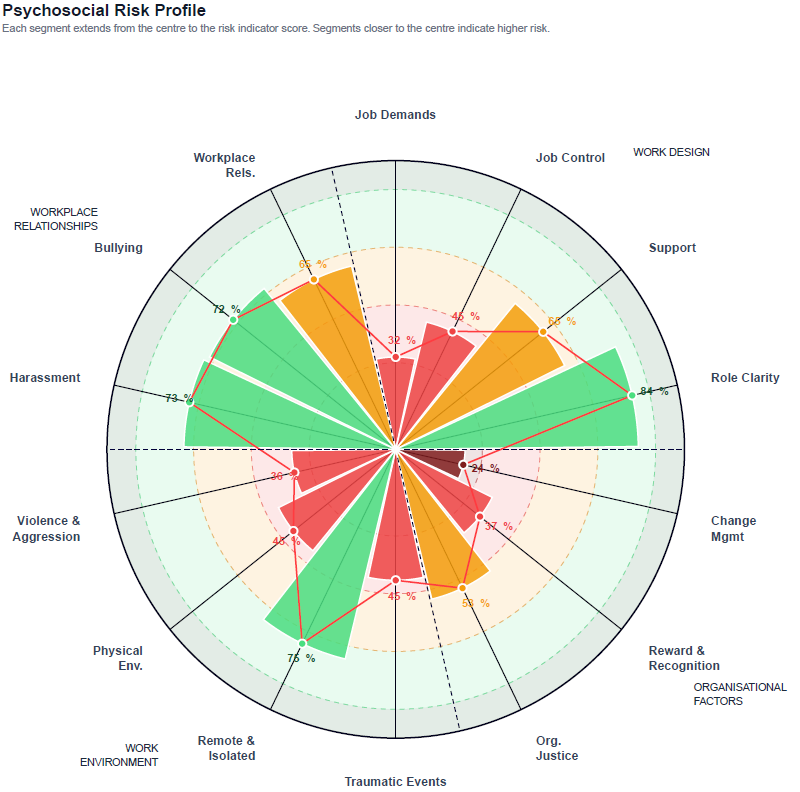
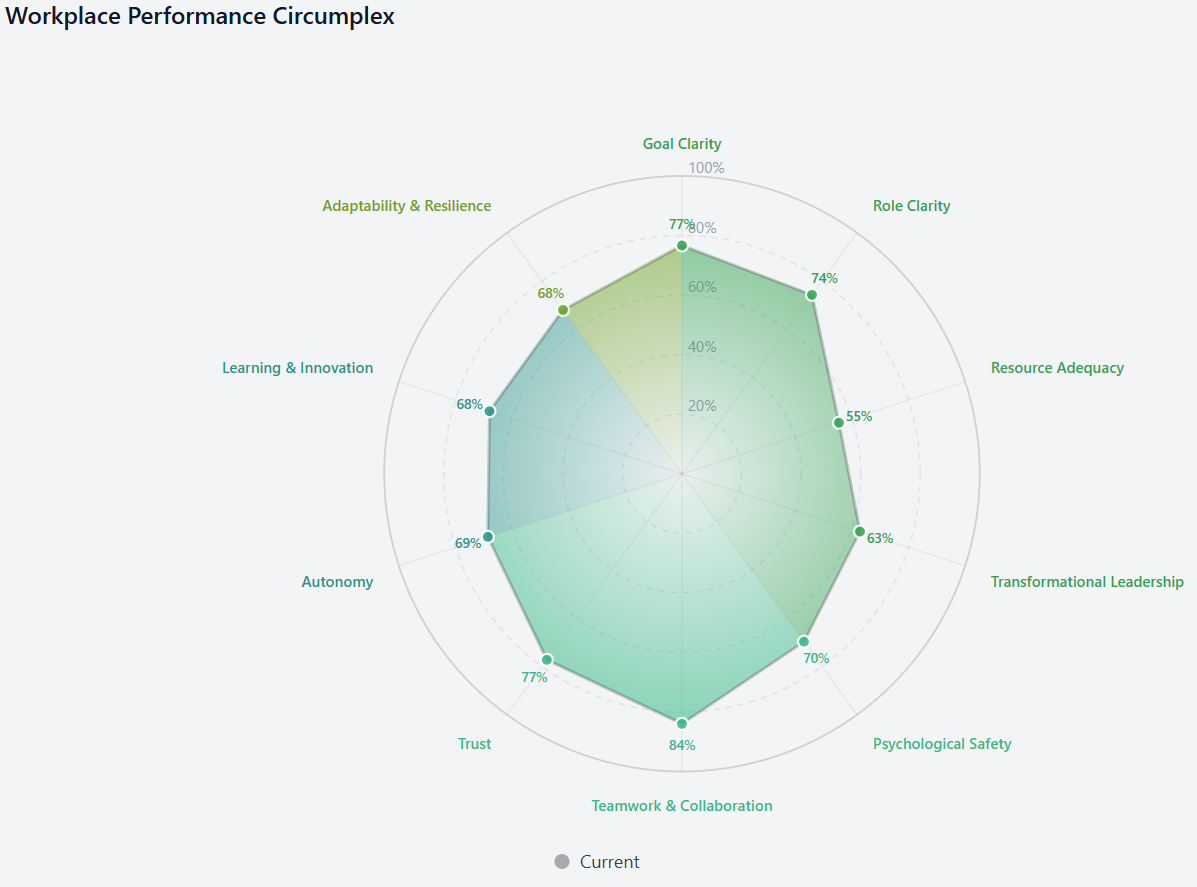
At the workforce level, two instruments work together: the WSS measures the climate conditions that drive performance, while the PRS assesses psychosocial risk in line with Australian WHS legislation. Together they provide a complete picture of workforce health and effectiveness.

Legislative alignment: PRS maps to Safe Work Australia — Managing Psychosocial Hazards at Work (2022) and WHS Regulations 2023

Scale

WSS: 50 items · PRS: 52 items · 7-point scale

Domains

  • WSS — Structural
    Goal clarity, role clarity, resource adequacy, transformational leadership
  • WSS — Relational
    Psychological safety, trust, teamwork and collaboration
  • WSS — Growth
    Autonomy, learning and innovation climate
  • WSS — Adaptive
    Adaptability and resilience
  • PRS — Work Design
    Job demands, job control, support, role clarity
  • PRS — Organisational
    Change management, reward, organisational justice
  • PRS — Work Environment
    Traumatic events, remote/isolated work
  • PRS — Relationships
    Violence/aggression, harassment, bullying
PRS Psychosocial Risk Profile
Click to enlarge

PRS Psychosocial Risk Profile

WSS Workplace Synergy Circumplex
Click to enlarge

WSS Workplace Synergy Circumplex

Online Training

Becoming a Collaborative Leader

An introduction to an online training program — exploring what collaboration and complexity have in common, and why collaborative maturity is an essential skill for today's leaders.

  • Know your problem — simple vs complex
  • Know yourself — enablers and disablers in your personality
  • Know the other — emotional and collaborative intelligence
  • The price and gift of collaborative maturity
Watch on YouTube

Interested in using these instruments?

Contact Dr Neil Preston to discuss which instruments are right for your organisation.

Get in Touch