
Research & Resources
Insights & Resources
Research papers and practice insights from Dr Neil Preston on collaborative leadership, team performance and organisational psychology.
Becoming a Collaborative Leader — Paper Series
An 18-paper series exploring the psychology of collaborative maturity — from the foundations of genuine dialogue and emergent leadership, to personality, resilience, and the shadow side of organisational life. Each two-page paper is written for practitioners and draws on peer-reviewed research in organisational psychology.
These papers are discussion papers and practice insights intended for professional and organisational development purposes only. They do not constitute clinical psychological advice — if you are experiencing personal or mental health difficulties, please seek support from a registered health professional.
Online Course
Creating Collaborative Leaders
A 30-video program exploring the psychology and spirituality of collaborative maturity across five modules. Drawing on organisational psychology, philosophy, and anthropology, the course develops leaders who can tackle complex and wicked problems — progressing from diagnosing complexity and building self-knowledge, through understanding others, to mastering emergent design practices. Delivered as an unlisted YouTube series with downloadable course materials.
What is collaborative maturity?
Becoming a Collaborative Leader
The Psychology of Collaborative Maturity
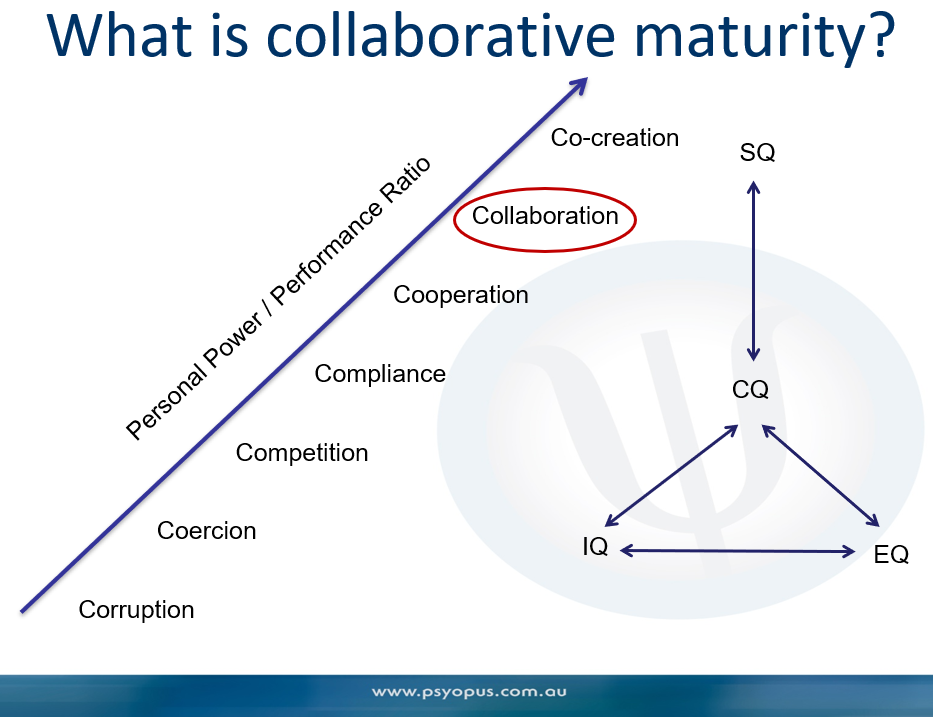
Introduces the collaborative maturity model — a continuum from coercion and competition through to genuine collaboration and co-creation. Argues that true collaboration prioritises performance over personal power, and that leaders must know their problem, know themselves, know others, and accept the real price of collaboration.
Download PaperConditions for Dialogue
Why Dialogue Matters
Challenges traditional 'diagnostic' organisational development in favour of dialogical approaches better suited to wicked and complex problems. Outlines seven essential conditions for genuine dialogue: power neutrality, psychological safety, turn-taking, genuine inquiry, serving performance over power, ambiguity tolerance, and self-knowledge.
Download PaperEmergent Design
Leading through Divergence, Dialogue, Convergence and Commitment
Argues that collective intelligence is an emergent property arising from conditions — not individual IQ or heroic leadership alone. Introduces Emergent Design Practice and explains the key skill of 'pivot thinking': knowing precisely when to shift from divergent open dialogue to convergent commitment and action.
Download PaperStrategic Planning through Emergent Design
The Oblique Way
Introduces 'obliquity' — the technique of approaching strategic goals indirectly rather than through rigid linear planning. Argues that good strategy starts in the middle of the planning hierarchy, that form should always follow function, and that any design should be stress-tested for principled simplicity and organisational coherence.
Download PaperEstablishing Collaborative Leaders through Emergent Design
Change through Communities of Practice
Challenges the Western myth of heroic planned change, exploring emergent change as an inherent property of complex systems that leaders can only 'manage at the margins.' Introduces 'negative capability' — tolerating ambiguity and provisional knowledge — and argues that sustaining collaborative leadership requires ongoing communities of reflective practice.
Download PaperFrom Compliancing to Alliancing
Creating a Culture of Collaborative Maturity
Distinguishes quantitative alpha change from deeper gamma change in human systems, arguing that complex challenges require alliance cultures rather than compliance cultures. Alliance cultures replace blame attribution with shared commitment, equal painshare/gainshare, open-book accountability, and genuinely collaborative decision-making.
Download PaperWhat is the Relationship between Personality and Performance?
From Trait to State Models of Leadership
Critically examines type-based instruments like the MBTI, arguing they lack discriminant validity to predict performance. Meta-analytic research points instead to the Big Five (OCEAN) model — with decision readiness, emotional stability, and conscientiousness as the strongest predictors. The central argument: creating the right conditions for performance matters more than any personality type.
Download PaperConfronting and Taming the Organisational Shadow
Naming and Claiming Behind-the-Scenes Decisions
Drawing on Jungian psychology, explores the 'organisational shadow' — the unowned informal rules of power and decision-making operating beneath official culture. Argues that blame-and-shame cultures enable scapegoating rather than problem-solving, and that collaborative maturity requires name-and-claim cultures where collective responsibility is cultivated.
Download PaperWhat is all this Emotional Intelligence Stuff all about?
The Challenge of Organisational Autism
Challenges the overemphasis on IQ in organisational life — cognitive intelligence accounts for only ~4% of variance in performance outcomes. Drawing on Goleman and McGilchrist's divided brain thesis, warns that organisations risk becoming 'increasingly autistic,' privileging cold logic over the pattern recognition and ambiguity tolerance that complex problems actually require.
Download PaperSpiritual Intelligence
Doing it Just for the Hell of It
Extends the collaborative maturity model to Spiritual Intelligence (SQ) — a fourth dimension beyond IQ, EQ, and CQ. Distinguishes collaboration (still goal-directed) from co-creation (autotelic, participation for its own sake). Drawing on theology and philosophy, it argues the highest form of leadership is service — not directed to an outcome, but arising from the sheer joy of participation in something larger than the self.
Download PaperOn Civility and the Practice of Virtue
With workplace incivility doubling between 1998 and 2011, presents compelling evidence that rudeness is deeply costly — groups exposed to even mild rude behaviour perform up to 61% worse on cognitive and creative tasks. Drawing on Aristotle, argues that virtues like patience, reciprocity, and turn-taking must be actively practiced as leadership habits and consistently modelled.
Download PaperBuilding Personal Resilience
Defines resilience not as imperviousness to stress but as the capacity to recover and maintain adaptive functioning. Identifies five key protective factors: internal locus of control, emotional regulation, avoiding catastrophising, drawing on meaning and spiritual resources, and practising mindfulness and heartfulness. Notes our negativity bias — negative experiences stick like Velcro while positives slide off like Teflon.
Download PaperWhat may be the 10 Conditions for Collaboration to Emerge?
Synthesises the series into a practical checklist of ten conditions necessary for genuine collaboration: compelling purpose, power neutrality, psychological safety, decision influence, turn-taking, sufficiency, ambiguity tolerance, mature emotional intelligence, selecting for collaborative skills, and organisational support. Grounded in the series' central thesis: leadership is values and behaviours worthy of imitation.
Download PaperTaming Toxic People — Part 1
The Origins of Psychopathic Personality
Examines the origins, neurological underpinnings, and behavioural characteristics of psychopathic personality in the workplace — people who are charming, fearless, lacking in genuine empathy, and emotionally colour-blind to others' feelings. Explains how brain structure differences result in the absence of social cues and anticipatory anxiety that ordinarily regulate pro-social behaviour.
Download PaperTaming Toxic People — Part 2
Surviving a Psychopathic Boss
Focuses on recognising and surviving a psychopathic boss — describing warning signs, the four roles psychopaths assign colleagues (Patrons, Pawns, Police, and Patsies), and practical survival strategies. Explores how to psychopath-proof an organisation through transparency, decentralised decision-making, and collaborative culture, arguing psychopathic behaviour flourishes in secrecy and competitive shadow cultures.
Download PaperAn OCEAN of Personality
How Does Personality Affect Team Performance?
Explores the Big Five (OCEAN) personality traits in depth and their relationship to team performance. Research shows teams with elevated conscientiousness, agreeableness, and openness tend to perform better, with diversity in extraversion and emotional stability also contributing. Recommends treating the team as a personality in its own right and managing team boundary conditions rather than individual profiles.
Download PaperAn OCEAN of Personality
How Does Our Personality Affect Dialogue with Others?
Traces how each of the Big Five personality traits shapes individual dialogue styles — illustrated through five vivid character portraits: the open explorer, orderly converger, extraverted dominator, agreeable mediator, and neurotic withdrawer. Argues for personality diversity in teams, where each trait brings genuine strengths to collective dialogue alongside its characteristic blind spots.
Download PaperImitation, Desire and the Toilet Roll
How Mimetic Rivalry Makes Toilet Paper Violent
Drawing on René Girard's theory of mimetic desire, uses the COVID-19 toilet paper panic to explain that humans desire objects not for their intrinsic value but because others desire them — and that when mimetic contagion reaches a tipping point, violence and scapegoating inevitably follow as mechanisms to restore social order. Argues that the real solution to collective crises lies in focusing on conditions and solutions rather than finding someone to blame.
Download Paper